Blog article
Supporting someone going through a health challenge
When someone is struggling with an illness or health challenge, it can be difficult not only for the person who is unwell but also for the people who care about them.
You may find it uncomfortable to sit with their suffering, feel you’re saying the wrong things and in turn find it hard to know how to support them.
If you don’t know what to say or do, you may find yourself simply distancing yourself or ‘giving them space’ – and if enough people do this, a person who is unwell may find themselves isolated and unsupported, which may even exacerbate the condition.1
Given the benefits of good social connections1, particularly during health challenges, learning how to be a supporter for someone you care about is an important skill we could all benefit from.
In this article
- How to educate yourself
- The Comfort In, Dump Our Model
- What not to say
- How to comfort someone?
- Psychologist supported suggestions
- When to seek help
Educate yourself
When a friend or family member is going through a health challenge, a great first step is to educate yourself on their condition. This could help you understand what kind of support to offer and may relieve your loved one of having to do the work of explaining it to you. Make sure you seek out evidence-based information, including government health websites and publications and qualified health professionals.
Keep in mind that different conditions (particularly in mental health) can manifest differently for different people, so try to be open to hearing your friend or family member’s personal experience, and try not to make assumptions.
Comfort In; Dump Out
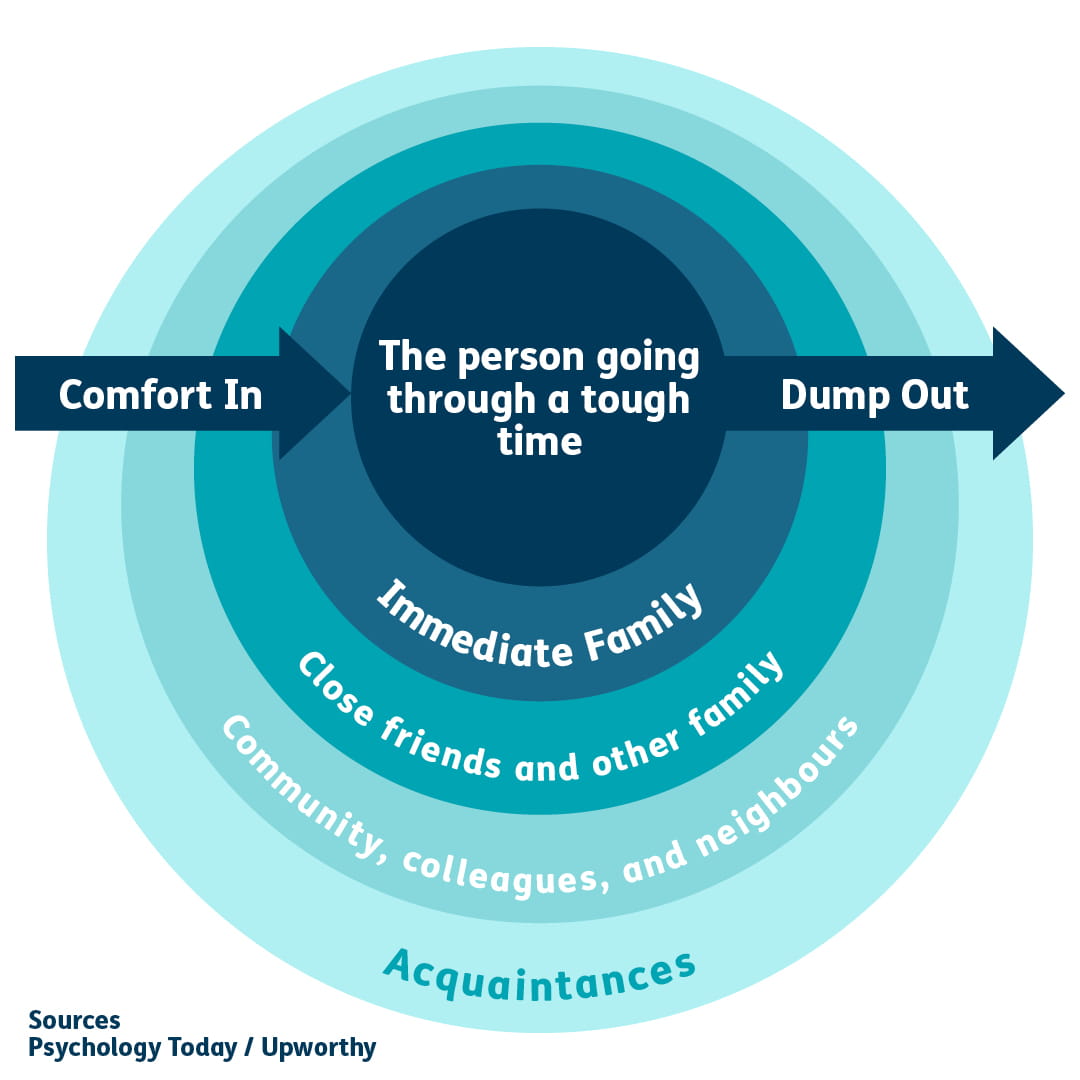
The Comfort In; Dump Out model2 or ‘Ring Theory’ may offer an easy-to-understand approach to dealing with someone else’s health challenges. Qualified psychologist, Marny Lishman says “Whilst it might not be useful to everyone going through a crisis, it may help some people who feel overwhelmed with the emotional burden of dealing with a health issue.”
If the person going through a difficult time is someone close to you, you may find that it takes a toll on your own mental health, meaning you also need some support.
The basic premise of Comfort In; Dump Out (CI;DO) is that the person with the health challenge is at the centre of a circle, and everyone else exists in concentric rings based on closeness to the person. Comfort should be offered to those in the more central circles and sought from those more distant.
Immediate family members, for example, should offer only support to the person suffering but may seek comfort from (or ‘dump’ on) more distant family and friends.
If, say, your parent was unwell, you would offer them support, and you wouldn’t complain about how hard it was to your siblings. Instead, you might call a cousin or unrelated friend to debrief.
What not to say
Here are some potentially unhelpful tactics that you should aim to avoid, supported by qualified psychologist, Marny Lishman.
- At least you have...!3 Attempting to push gratitude onto someone who is struggling could just be invalidating their struggle and may come across as shaming.
- Be strong/Don’t cry/Cheer up!3 Your loved one’s health challenges are likely to involve grief, fear, sadness, and even anger. If you attempt to push these aside, you may be creating an additional burden for them by having to mask their pain.
- I know just how you feel.3 Although the intention behind this may be empathy, what it may actually convey is that you’re not open to hearing about their unique experience.
It’s important to remember, we can never know exactly what someone else’s experience is.
How to comfort someone
To offer comfort to someone who’s struggling, it might be helpful to focus on what you CAN change. You cannot change the course of their health challenge, so instead, focus on how you can help.
Here are some steps to offering comfort.4
- Really listen. Let them speak, ask clarifying questions, and show you’re present. Try not to jump in with advice or attempts to fix anything, and resist cutting in with your own stories. Just give them space to speak. Marny adds, “People don’t necessarily need their problem solved by you (and in most cases you can’t), they need your empathy.”
- Let them know you’re there for them. When someone is struggling, they may feel like a burden to others. Assuring them that you are happy to be available for conversations or practical help can be incredibly comforting.
- Ask questions. Instead of assuming what their needs are, find out. Seek to understand what they want and need. What are they struggling with? What do they need help with? What, specifically, would make their life better right now?
- Lifeline: 13 11 14
- Suicide Call Back Service: 1300 659 467
- Beyond Blue: 1300 224 636
- MensLine Australia: 1300 789 978
- Kids Helpline: 1800 551 800
- Headspace: 1800 650 890
“Everyone is different, some people need company, some people want to be left alone to process their feelings. You won’t know this if you don’t ask” says Marny.
Psychologist-supported suggestions
In these situations, offering practical assistance can be one of the best ways to show you care.
Asking the question, ‘How can I best support you?’ may get you a clear and direct answer or could create an additional burden for the person as they try to figure out what to ask you for or struggle with their own issues around asking for help.
It may be more helpful to offer specific help (which you may have received information about while you were undertaking the ‘listening’ step!)
Marny offers the below as a good place to start if you’re feeling unsure:
‘I’m going to the supermarket later today, can I grab something for you?’
‘Would you like me to drop you at your medical appointment this Thursday?’
‘How about I take the kids to the park this weekend so you can get some time to yourself?’
‘I am always here, so please do ring me if you need to talk’
‘If you would like to join us for a BBQ over the weekend for some company, please let us know.’
When and how to seek additional help
If your friend or family members’ needs are more than you’re able to accommodate, it may be helpful to find out what services are available to them in their specific situation. Marny suggests gently mentioning when a psychologist has been of help to either yourself or someone close to you.
“We also want to suggest rather than tell, as therapy is always better when they themselves reach this as a support”
Urgent support links and phone lines 24 hours, 7 days

1 Better Health - Strong relationships, strong health
2 Psychology Today - How to respond to people in crisis
3 Mental health Coordinating Council - Recovery Orientated Language Guide
4 NSW Health - What is appropriate language when speaking to someone living with a mental health condition?
This article contains general information only and does not take into account the health, personal situation or needs of any person. In conjunction with your GP or treating health care professional, please consider whether the information is suitable for you and your personal circumstances.