Blog article
Running shoe rotation: A Q&A with a Brooks Half Marathon Pacer

This article is sponsored by Brooks.
It’s officially HBF Run for a Reason season and if you’re lacing up for this year’s Brooks Half Marathon and wondering about shoes and their significance in your upcoming triumph, allow us to introduce you to Brooks Pacer/Senior Physio/Self-proclaimed shoe nerd, David. David has paced for HBF Run for a Reason a number of times, and “loves seeing a whole lot of runners hit their goals and actually enjoy the process.”
What is a pacer? Think of them as a steady, confidence boosting running buddy. In a half marathon, a pacer is a person that runs the entire 21.1km at a consistent pace to help you hit a specific finish time, hopefully taking out some of the guesswork on race day.
Over to David who is going to run us through some of the top questions you may have around shoe rotation, and why it should be part of your training and injury-prevention plan.
Question time.
Q: As a half marathon pacer, how many pairs of running shoes do you personally rotate during training and why?
A: I have quite a few pairs of shoes in my rotation at any one time. While having more than two pairs is by no means necessary, there are a few reasons for this:
- It’s good to change up shoes so that you make small changes to your gait and load your lower limbs differently each run.
- Different shoes are good for different runs
- Max cushion/more forgiving shoes for easy/recovery/slower days
- Daily trainer / traditional shoe for a few general runs each week
- Carbon-plated super shoes for faster training days and races
Q: For someone training for their first half marathon, what’s the minimum number of shoes you’d recommend rotating?
Q: What’s the biggest benefit you’ve noticed from rotating shoes? Injury prevention, comfort, performance, or something else?
A: Definitely not bank balance! For me and for a lot of my clients, injury prevention is the biggest benefit to rotating shoes. Having higher stack, more reactive foam allows people to back up consecutive days of running with less chance of injury.
I also think it can increase motivation when people have a slightly different pair of shoes to put on and get rolling in.
Q: Do different shoes feel better on different days (easy runs vs long runs), and how should runners think about that?
A: High stack / max cushion shoes will usually feel better on easy runs and long runs (at slower than race pace) as they are designed to absorb a fair bit of ground reaction force and are generally good for lower cadence sessions. Faster tempo shoes, particularly carbon-plated shoes (like the Brooks Hyperion Elite) will usually feel better on speed sessions and race day.
Q: What are the top 3 things runners should prioritise when choosing a training shoe for a half marathon?
A: I would say comfort, injury prevention, and speed vs stability. Here’s a bit more on each.
- Comfort is absolutely my number one priority. At the end of the day, the more training you can do without injury, the more you’ll enjoy race day and the better you’re likely to run. So having a shoe that feels great will trump any performance benefits.
- Injury history is also important. Understanding which shoes tend to provide additional support, offload the foot and ankle and reduce ground impact forces will all help to reduce risk of injury.
- Speed vs stability: as shoes become faster, they often become less stable. Look into understanding the goal of the shoe (ie run the fastest race possible vs run the most comfortable race possible.) This will help to determine shoe type for the Brooks Half Marathon.
Q: Should runners train in the same shoes they plan to race in?
A: In my opinion, yes absolutely, but not too many times. Whilst it’s important to have tried out your race wheels before the big day to make sure there are no blisters or niggles waiting for you around the corner, the higher the mileage on the shoe, the slower it will go (as a very general rule of thumb).
So, for the Brooks Half Marathon and other big races, I like to race in shoes that have done less than about 80km. I’ll often take them out of the box for one or two faster training runs (like a threshold session) and then not use them again until race day.
Related reading: Choosing the right running or walking shoes
Big thanks to David! See you at the finish-line, runners.
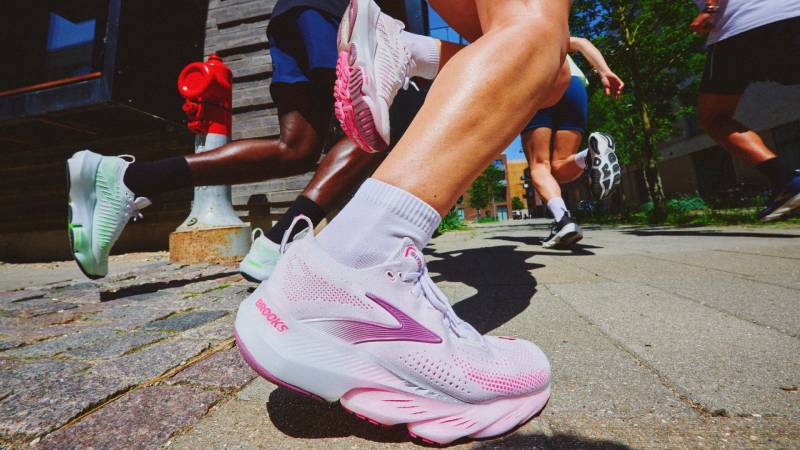
Brooks Half Marathon-ready runners, and why we love them
Did you know? Brooks have a dedicated run research team working out of a custom-built lab whose sole job is to design shoes that reduce your chance of getting injured and increase your enjoyment of your run.
We asked Daniel, Brooks Product & Education Specialist, to fill us in on what’s to love about his top 3 for those training for the Brooks Half Marathon.
- Brooks Hyperion Max
Hyperion Max is your best choice for longer training runs especially when you intend to push your session towards your goal race pace. Its increased stack height offers more protection to runners. Many people will also use this as their race day shoe. It’s that versatile. - Brooks Hyperion Elite
Hyperion Elite as the name suggests is Brooks’ fastest shoe. The midsole is entirely DNA Gold, and it also features a carbon plate. It is more aggressive than the Hyperion Max and built for more serious and experienced runners. - Brooks Glycerin Max
To complement these shoes, you could add something with lots of cushioning for your longer, slower runs. These runs are very important to help maximise your training and your tolerance to running further. These runs should be in a cushioned shoe rather than a performance shoe. The Glycerin Max features a glide roll rocker and an incredible stack of DNA Tuned foam. The shoe is designed to offer a protected experience and move for you. Perfect for your long runs or when you find yourself a bit sore in your training.
This article contains general information only and does not take into account the health, personal situation or needs of any person. In conjunction with your GP or treating health care professional, please consider whether the information is suitable for you and your personal circumstances.